
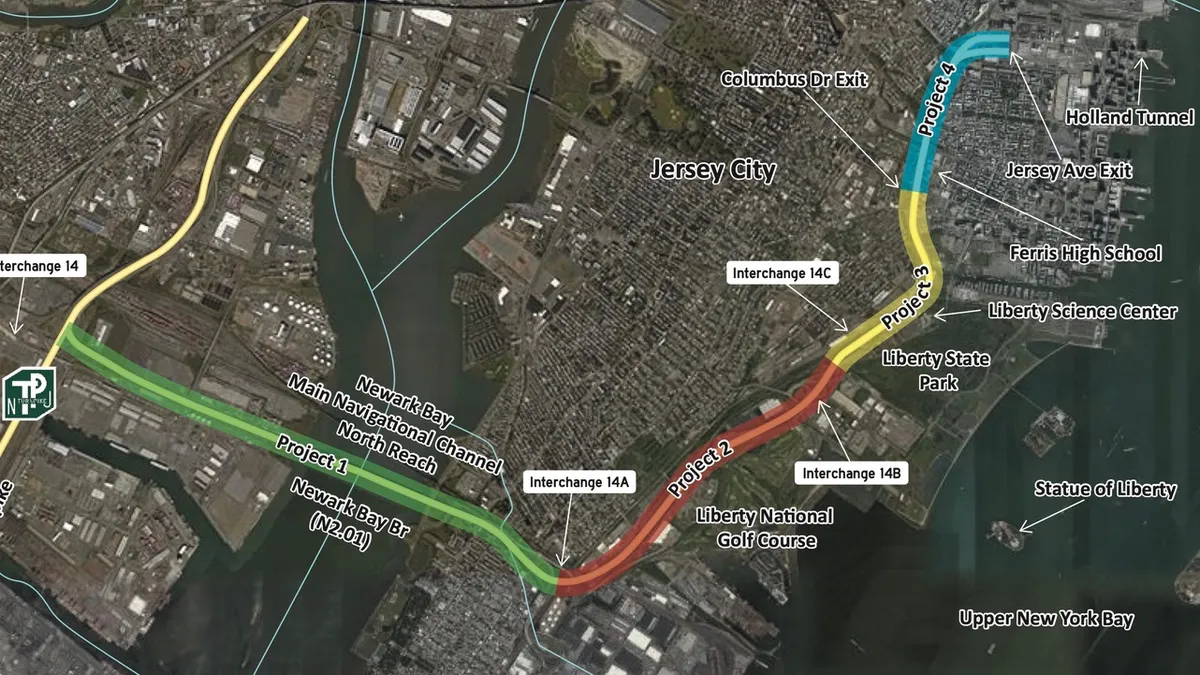
When I am running late for Manhattan and a lapse in judgment strikes, I have my husband drop me at the Harrison PATH station. One route is the 280 bridge that connects to the turnpike another route is the Newark Bay Bridge, officially the Vincent R. Casciano Memorial Bridge, a steel through-arch, continuous across three spans. It crosses Newark Bay, connecting Newark to Bayonne.
The light rail to Newark PATH is always faster, but I avoid Newark Penn Station, because it is disgusting. I love public transit but I am not in a cult, Penn needs help. As an Angeleno, I cling to the fantasy of the car (yes, I am full of contradictions) a stubborn, inherited faith, though it is never faster and always a nightmare. Newark is threaded with streets, some eight lanes wide, engineered not for arrival but for throughput; to drive to Newark, or through it, is to enter a labyrinth of delay, a delay worth it to some to avoid “the blacks.” The NJ Turnpike widening project, we are told, will make this better.
“Just one more lane dude!”
You might mistake the Turnpike widening project as a Hudson County affair, unless you are an urbanist, or a flâneuse like me. That misdirection is deliberate. New Jersey imagines itself a federation: each city a sovereign state, each borough a principality. They call it “home rule”—a cousin of states’ rights. It serves the same master. It fractures advocacy into manageable parcels, so whiter, wealthier enclaves can lobby for nicer things while the machinery of hegemony grinds forward unimpeded.
So advocates rallied to save Jersey City. Power threw them a bone, then dumped the rest on to Newark, a working-class, predominantly Black city.
A Christmas gift to Jersey City from Governor Murphy read:
“Elimination of New Travel Lanes Between Interchanges 14A and 14C.
New Ramps Will Provide a Direct Connection From Interchange 14A to Port Facilities in Bayonne and Jersey City – Reducing the Mixing of Trucks Traveling to and From the Port with Local Traffic Within the Interchange.
Changes to Save Approximately $500 Million Off the Total Cost of the Projects – Enabling Infrastructure Investments Elsewhere in Hudson and Essex Counties.”
“Elsewhere” means Newark. It is always Newark, until the Black people are removed, as they were in Jersey City.
The change will funnel more traffic, diesel trucks above all, into Newark, specifically the Ironbound and South Ward. I walked to the DMV (MVC in NJ) in the South Ward once: not a bike lane, light rail, or tree in sight. On the way back, I watched a bus pull away, leaving a running woman behind.
The problem is not solved, only displaced. It could have been avoided with foresight, though perhaps those in who knew, knew they could not stop it outright—only help Jersey City, and pretend to care about the broader implication, once the inevitable settled.
Who didn’t see this coming? I have lived in the “City of New Jersey” since 2017, and I have watched this ritual repeat.
This is New Jersey’s largest climate decision of the decade, and Newark, Elizabeth, Bayonne, Jersey City, and the entire port region will inhale its consequence. The atmosphere does not care if Jersey City is spared for now. This was a climate crisis fight disguised as a local traffic dispute.
And it is a sadness, this performance we keep up, the pretense that we are not doing exactly what we are doing.
“You can’t do this to Newark!” Whatever dude….
The climate crisis does not recognize political boundaries. Functionally, North Jersey is one place. The people in power know this. That is why they play the local rights game, even as they act regionally, doing precisely what they want.