
The urban critic’s role has never been more vital, yet more untenable. Our currency is a refusal, a refusal to accept the shockingly small sums for which we are asked to bargain away our streets. To be a critic today is to stand in opposition to the machinery of “pragmatism,” shouting not in opposition to solutions, but to the shutting down of inquiry.
To paraphrase Henri Lefebvre, “Space is a means of production,” and thus, a means of control. The ceding of our public right-of-way to corporate-owned autonomous vehicles is not a technological evolution; it is a spatial regression. It is a process that drags us, quietly and on rubber tires, toward a new feudalism.
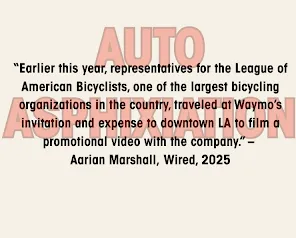
I read a recent article in Wired (not engaged in solutions journalism for this revealing piece), and the autonomous vehicle industry is not just about engineering cars, but also about engineering consensus. Waymo sponsors the National Bike Summit. Zoox and Waymo partners with local cycling advocacy groups like BikeLA and BikeHouston, sharing sponsor lists with Caltrans and AARP California. The embrace is seamless, the funding a gentle lubricant.
(They are really not paying you folks, enough for this nonsense.)
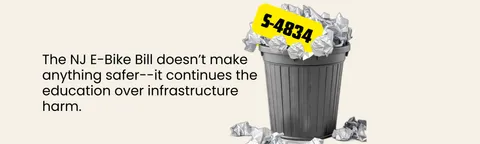
This is where advocacy and its handmaiden, “solutions journalism,” become death by a thousand concessions. Much of contemporary bicycling advocacy and urbanist commentary functions as a poorly paid agent of hegemony, narrowing public discourse to a curated range of “palatable” topics, four classes of bicycles in New Jersey, the national 3 feet campaign that encourages education over infrastructure.
The contempt for genuine critique permeates the non-profit industrial complex, which demands a storytelling lens aligned with donor objectives.
The solution must be measurable, and too often, the metric leads directly back to a board member’s pet project. This symbiosis between nonprofits and neoliberal fixes is no accident.
And since grant-making requires a gloss of community engagement, hegemony had a solution: Why not bring journalism to the party?! Which is how we get “Solutions Journalism,” which is not a discipline of a kind of journalistic inquiry, but as a mechanism of capture. It uses the smear of reportage to validate solutions proposed by power, laundering them through the press's credibility.
When I started my media venture, I was puzzled: why was I being told to seek funding not from those who support journalism, but from those who bankroll urbanism? I thought, I write urban criticism—and the people funding urbanism blogs are developers, bike companies pushing mopeds, and autonomous vehicle firms. How could that possibly align?
My not-white face must have given people the impression that I was not seeking to create a vehicle to expand discourse on options outside of Auto Asphyxiation but rather a gimmick to feed myself.
The solutions journalism model is fundamentally antagonistic to the critical soul of journalism.
Journalism is not a priori. Journalism cannot be forced into the rigid, pseudo-scientific structure of the Toulmin model (claim, grounds, warrant, backing, rebuttal), which seeks a conclusive argument. The foundational Who, What, When, Where, and Why is open-ended investigation.
The purpose of journalism is to cultivate public critical thought, not to deliver a pre-packaged answer. Solutions journalism inverts this. Its entire raison d'être is to limit discussion to topics for which the wealthy have already deemed the solution “best.”
The “solution-first” framing forcibly reorders discourse:
1. It suppresses a pure problem statement, foreclosing discovery.
2. Its claim must be a “solution proposal,” never a neutral observation.
3. Its grounds become only evidence supporting that solution, ignoring a full spectrum of facts.
4. Its warrant is an assumed, unquestionable premise: that the only valuable speech is immediately actionable.
5. Counterarguments are framed not as complexities to be understood, but as failures of the proposed fix.
The effects are deeply harmful. They silence legitimate concerns, shift the burden of proof onto the critic, narrow acceptable perspectives to those offering “expert” solutions, and push for premature closure on profoundly complex civic questions. In New Jersey, those four bicycle classes are pure nonsense.
Giving our streets to corporate overlords is not a neutral act of progress. I am extremely skeptical of any bicycle “advocacy” group or typists masquerading as journalists surviving on the crumbs of these corporations.
There is a bitter irony at play: The same cyclists who waved Mandami and Katie Wilson's sign and rightly demanded that politicians stop taking corporate money are now found taking corporate money to turn our streets into playgrounds for the wealthy, and their cars, their autonomous ones. The vehicle may be quieter, but the hierarchy it reinforces is age-old. The critic’s task remains to make the quiet part loud again, to refuse the tidy solution, and to reclaim the right to the city from those who would merely manage its surrender.