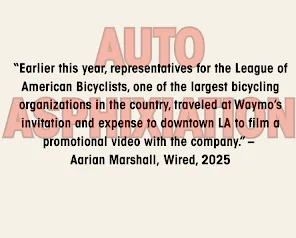

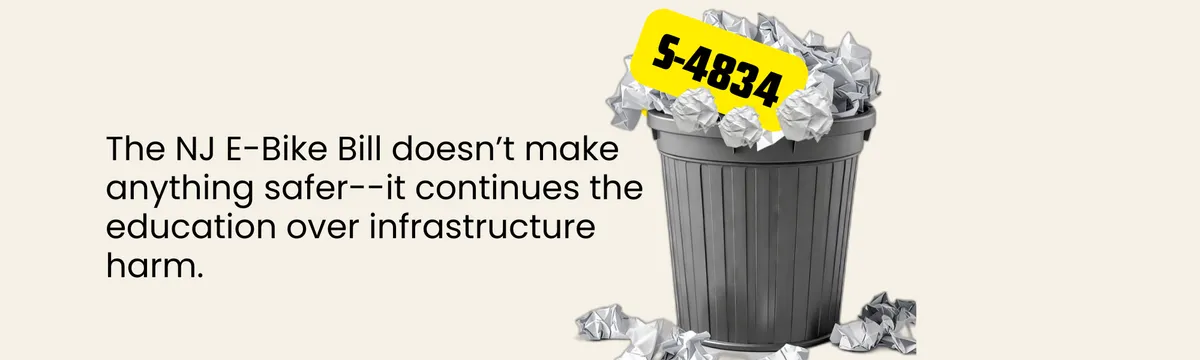
NJ Senate President Nick Scutari is on a roll. First, he wanted to remove subpoena powers from the Office of the State Controller via S-4924. Now he wants to help bicyclists. I don’t want any more help from Nick. His Bill S-4834 is overreaching and part of a long, dishonest auto asphyxiation conversation. The bill and the discourse over electric bicycles are a case study in elite capture. Its call for licensing is not about public safety.
If safety tumbles out of someone’s mouth regarding cycling, it typically rings with the familiar sound of hollowness: it routinely serves as a guise for abdicating corporate oversight. Behind this hollowness is the “free market” phantom. Industry writes the rules, so the public bears the risks, and they retain their sovereignty to call mopeds bicycles, call algorithms innovations, and to encourage education rather than infrastructure.
This bill is poorly conceived, and no part of it merits discussion.
This bill is part of a systematic rebranding of the motorized pedal cycle and disparagement of all forms of transportation that are not privately owned cars. Electric motorized pedal cycles with throttles have greater mass, higher speed, and much more kinetic force. They should not be seen as just another “e-bike.” It is not. Mopeds are a distinct class with an existing framework for licensing, insurance, and safety. The semantic sleight of hand is a political move. Erasing the lines helps manufacturers avoid responsibilities. It shifts risk and liability to bicyclists and pedestrians using shared infrastructure.
Pretending that a throttle-equipped moped and a Class 1 pedal-assist bicycle are equivalent is not an honest confusion. You’re not being honest, so why should we entertain you? It is a manufactured one that limits options for people trying to free themselves from the automobile. Accepting this false category means giving in to a piecemeal, reactive approach to governance. This approach addresses harm only after it happens, instead of establishing clear, preventative standards at production. This is a failure of collective imagination and yet another concession to hegemony dressed as “safety.”
If this bill were about helping the public, it should be looking beyond the narrow horizon of corporate libertarianism.
Public safety and equitable infrastructure are not market commodities. They are collective goods made through democratic regulation. Democracy is not for oppressing the public NICK!
The first step is to reject the industry’s script and name road vehicles truthfully. Also, refuse laws that “punish the entire class” rather than addressing the system that causes conflict.
The rules of the road must be written for the public, not by the producers. This bill is for the producers, not the public.