
Rejecting urbanism’s reductive fixation on women as caregivers—and designing for desire.
Jennifer C. Nash and Samantha Pinto’s “On Exhaustion: Toward a Post-Care Feminism” names a tension I’ve long wrestled with—and now fuels my framework of Post-Care Feminist Urbanism. While my approach diverges from theirs, their work ignites a necessary rebellion against urbanism’s myopic obsession with only being able to see women as caregivers.
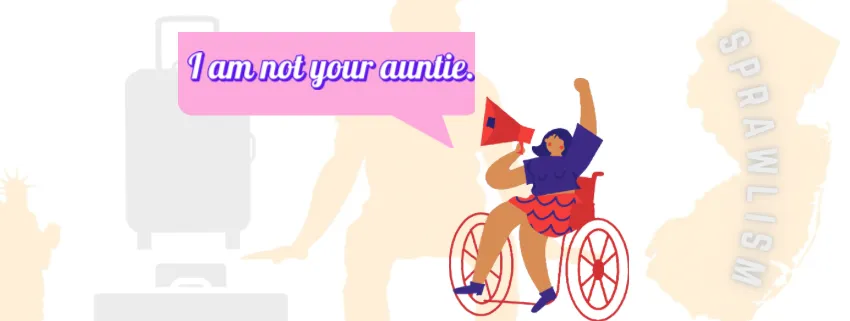
As a childless, middle-class homeowner with two advanced degrees—raised in Los Angeles, now in New York Metro—I’m told cities should “work” for me. Unburdened by care labor, I ought to glide through urban life. Instead, job postings for women over 40 shrink to “assistant” roles I reject; transit systems punish all but the abled and affluent; public discourse pathologizes my childlessness (“You can always be an auntie!”) all while reducing my safety to a talking point.
To all of this I say: Have you lost your mind?
Urbanism’s failure isn’t negligence toward caregivers—it’s active hostility toward women who exist beyond servicing men and children. Since its inception, planning hasn’t ignored women; it has engineered our exclusion. Dorina Pojani’s research reveals how early planners weaponized women’s concerns to render streets, parks, and transit hostile to our presence. Like racism, this is no accident: it banishes anyone not cisgender, white, male, and bourgeois from public life.
The “care paradigm” isn’t liberation—it’s a capitalist trap. By romanticizing unpaid labor, it perpetuates the notion that women are society’s permanent caretakers. This isn’t empowerment; it’s domestic slavery wrapped in neoliberal sentimentality. (To claim otherwise echoes the grotesque logic of “At least Sally Hemings got to go to Paris.") Care work is necessary, but conflating it with women’s worth—while draping exploitation in moral duty—isn’t progress. It’s bourgeois mystification.
The Radical Alternative: Pleasure Politics
When I critique urbanism’s sexism, I’m told to center care. But why must my body serve systems that erase my humanity? To borrow from Audre Lorde, we need an urbanism of Pleasure Politics—one that designs for women’s desire, not just safety or sacrifice. Imagine:
- Non means-test based universal socialized housing near city centers, not soley because of labor, but because diversity is the wonderful part of urban life.
- Transit designed for spontaneity (not just commutes),
- Parks with seating for conversation, not just child surveillance.
To paraphrase Marxist Feminist thought, “Capitalism must convince us that servitude is freedom.” Urbanism reduces childless women to “failed” citizens or “community aunties,” erasing our needs for autonomy, work, and joy. Care is not power: true power is refusing to be instrumentalized—by men, capital, or “neoliberal progressive” urbanists.
Post-care urbanism doesn’t neglect care—it explodes the prison of ‘care’ as identity, labor, and moral duty. I challenge us all: What would a city look like that frees women’s time, bodies, and imaginations?
Subscribe to our YouTube channel. Tomorrow we will be discussing Post-Care Feminist Urbanism and more on the Auto Asphyxiation podcast!